You probably aren't good at riichi yet; these pro books offer a glimpse of a tall mountain
As promised way back at the pro meet– where I played a round with one of these authors and was complimented by the other, by the way, ohoho– I’m going to review the strategy books I picked up.
(Both of these books (Uchikawa, Matsumoto) have been made available on Kindle digital since I wrote this.
I do not know what the deal is with physical availability on these books yet. I saw quite a few copies of both books at the event; about the quantity where, if they opened them to online sales today, they’d still be gone instantly from a hundred hardcore scene people buying them on the spot. So I presume a larger print run is coming.)
If you don’t mind me giving a bit of a lecture of my own, I recently overheard an online discussion in which old players advised a new player to read strategy books and theory. The new player angrily rejected the entire idea of studying the game or using someone else’s work to improve, saying that it was much more rewarding to instead slowly discover everything about the game on their own, at their own pace, than to obsess over the “optimal” move from some book.
This assumes quite a bit, but the first thing I’d say to anyone who thinks like this is that you don’t even know what you don’t know. That’s how much deeper the game is than you think, and how much more there is to learn. You can play for years without ever considering the advanced concepts; I certainly did. There’s nothing wrong with that, either. It’s just a game, there’s other stuff you can do with your life. But when you reach that wall and you commit to staying weak, expect to continue to lose. And you don’t get to complain about that, either: you chose it.
Consider, then, that perhaps, scholars and professionals of the game might have learned something worth sharing— something you would not have figured out on your own— from the thousands of hours of their lives that they have devoted to studying and competing. We do not seek their counsel to mindlessly X-Copy their moves; we want to use their advice to elevate the way we think about the game. After all, the game rarely actually comes down to rote repetition of optimal moves: it only looks that way when you don’t know enough. The more you know, the more there is to observe, and thus the more involving the game becomes.
I used to think riichi was just about sitting around and avoiding dealing in while waiting for the good tiles to roll in: I was deeply wrong.
So theory and strategy books are gifts, and thus I rushed to buy these English translations of older books by M.League pro players Kotaro Uchikawa and Yoshihiro Matsumoto. There is a wealth of mahjong texts by highly qualified authors in Japanese, but due to their niche audience and the particular nature of translating them— you need someone who not only is proficient in both languages, but also understands the game concepts in the depth that they're being discussed— not a lot of them have been translated. These two books have been translated by JPML professional Jenn Barr, who more than meets those requirements.
The Gamesoft Robo Fun Club is a solo labor of love that depends entirely on paid subscriptions from readers to exist. If you enjoyed this piece and you'd like to see more, I'd love to see you become a regular or paid subscriber. Paid subscribers get exclusive posts and keep me fed. Thanks for reading the pitch and hope to see you subscribe!
(There is a bit of mahjong text in unofficial translation, but only a few books (namely G Uzaku’s) have been translated at a professional quality: the rest suffer from rough translations that make no attempt to be readable in their attempts to disseminate raw info, as well as capricious translators who “skip the boring parts” and sometimes insert newly-invented racial slurs into the text. I wish I was kidding.)
The Essential Playbook, Kotaro Uchikawa
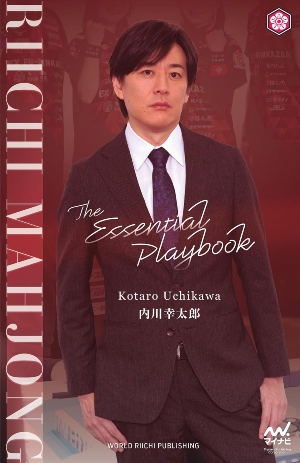
(Should you read Japanese, this is the same book as 現代麻雀の絶対手順 (Absolute Lines of Play in Modern Mahjong); I checked the contents and left the titles in Japanese for you to search if you like. After all, if you read the language, these books have been out for years and are very easy to get your hands on.)
Uchikawa’s book is targeted at players who already understand the basic theory and practice of the modern style of play, but are nevertheless in need of a thorough review. As such, this isn’t something you hand to a total beginner, but it does feed the many English-speaking players starving for guidance beyond the level of intro-to-theory texts like Daina Chiba's Riichi Book I.
(It is still probably best to start your journey into theory with the famous and free Riichi Book I, the best introductory guide to riichi strategy in English. That being said, Uchikawa’s book goes much deeper than RB1, and it shouldn’t be difficult to digest for any player who is already comfortable and confident in their grasp of the basic rules and ready to move on to strategy.)
In the foreword, Uchikawa explains a concept translated as “lines of play”, which I came to understand as a game plan for a given hand, from beginning to end. As we play, we see certain similar hand shapes and situations over and over again. Say we break these common shapes down and determine the discard that is always correct for the situation, the one which accepts the best potential draws and leads to the highest-scoring hand. We internalize that information: most accomplished riichi players can play fast most turns because we’ve already done this naturally. That backbone is what makes us strong players, and Uchikawa seeks to strengthen it.
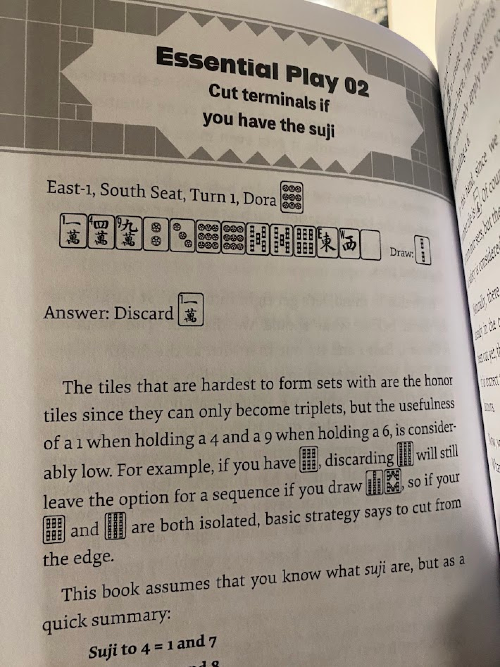
Thus Uchikawa leads us through the standard riichi gameplans for the most common types of hands (riichi, pinfu, value honors, honitsu, and tanyao). The chapters concentrate solely on how we deal with the tiles in our own hands, and hammer standard best practices into our heads. In each of 92 two-page segments, he introduces an example hand, explains exactly what is to be done with this sort of shape, and segues the subject into the next example.
This is not a didactic “when X, always do Y” type of text; Uchikawa explains precisely and in detail why he believes a move is better than other options, whether the answer comes from theory or from his personal experience. Uchikawa’s choices are not necessarily made on raw probabilistic tile efficiency, nor EV (expected value) like a learning model such as Mortal or MAKA would tell you to do, but he always offers a reasoned, logical explanation that takes them into account.
Uchikawa admits that some of the questions simply don’t have definitive logical answers (which do you discard first, the useless guest wind or the East tile that the dealer could pon for double east?) and come down to personal preference, but he also stands by the choices he makes. This is pretty important in mahjong, where consistency is key.
I want to clarify, as does Uchikawa, that these gameplans are “two-dimensional”; that is, in this book he purposely leaves out variables like the point situation, or the other player’s discards and calls. Though he is describing ideal plans for optimal play, the table situation— the three-dimensional part— often puts a wrinkle in those plans. Adaptation is required at the table. But that’s exactly why a good player needs a strong foundation: you can’t break the rules effectively without first understanding them.
In between the lessons are some breaks to talk about Uchikawa himself; a personal essay describing how he got involved with professional mahjong, as well as an interview from after he won the 10th dan tournament in JPML. Chapters are capped with glamour photos of “Ucchi” posing out on the street; yes, the pro mahjong scene can at times look quite a bit like the idol fandom.
Though advanced players will know have already learned many of these pointers, I believe the point that Uchikawa makes with this book is that just because you have learned the basics doesn’t mean you don’t need to keep those skills polished. It’s an excellent refresher course.
Balance Your Game, Yoshihiro Matsumoto
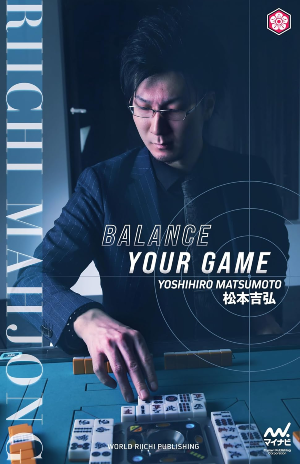
(Again, this is the same book as 初代Mリーガー松本のベストバランス麻雀 (First-gen M.Leaguer Matsumoto’s Best Balance Mahjong.))
I used Uchikawa’s phrase “two-dimensional” (not as an insult; he uses it himself) to describe the basic practices he outlines in The Essential Playbook; optimal moves you make when thinking only of your own tiles. In Balance Your Game, Yoshihiro Matsumoto throws us directly into the “three-dimensional” aspects of the game, namely taking the whole table into account rather than just the tiles that are in front of us.
Right away, Matsumoto stresses that the exact same hand can call for completely different approaches based on our score situations and the tiles we can see on the table from our opponents. This kind of “three-dimensional” thinking is essential for surviving and winning against advanced players: without it, you are stumbling in the dark.
When Matsumoto talks about “balance”, advanced players already know what he’s talking about, because we’re already in search of it. Keeping a balance between defense and offense— knowing when the right time is to take on an appropriately risky opportunity, and when to cut our potential losses and fold instead— is one of the hardest points in riichi. It doesn’t help that we sometimes lose when we make the right choice and win when we make the wrong one: just like Uchikawa’s basic lines of play, we need to understand best practices for these “three-dimensional” situations as well. This book is an overview of the aspects you'll need to think about when you're playing against the whole table, from situational push/fold judgment to the fuzzy science of reading what an opponent might be waiting on from their discards.
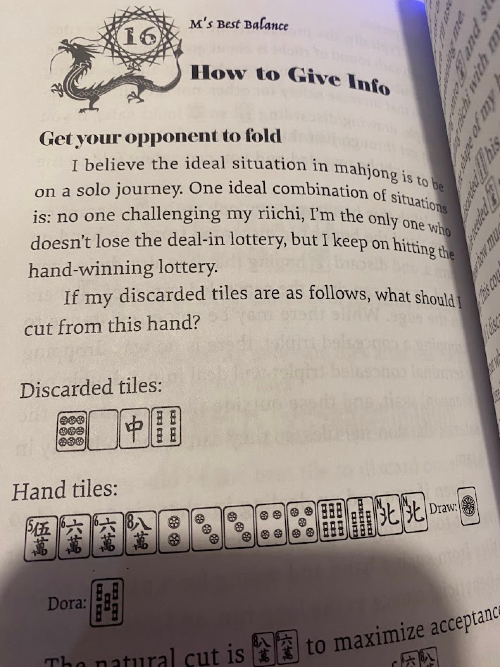
As such, this is a pretty advanced text which I would recommend to similarly advanced players. Reading this as a beginner without a couple of layers of awareness built up already will just be overwhelming. If you’re confident with your own tiles and want to start learning to read the table better, on the other hand, this is an excellent source that goes deeper than any riichi book available in English right now.
About a quarter of this book consists of a auto-biography of Matsumoto. Raised in a strict elite household, he details the way that a passion for mahjong crept into his life alongside the pursuits his family expected of him (he was also getting scouted as a baseball player in high school). He agonizes over his decision to move full-time into professional mahjong after racking up a successful record on the side from his regular job. He knows he has the stuff, but he knows his dad won’t accept it. And he doesn’t! And all Matsumoto needed to do to reconcile with Dad was make it to the highest league in Japan. How ‘bout that.
A feast for the starving
We are still in the “every scrap is sorely needed” stage of riichi strategy in English. Indeed, these books are the very first releases from the World Riichi Publishing imprint of the WRC pro mahjong organization. They’re coming in strong with two very necessary volumes from two of the strongest competitors in the world, and I look forward to future translations.
Between WRC and Mahjong Pros' efforts, the floodgates are really opening on riichi content in English. Just a year or two ago, even amidst a small riichi boom here in the States, this situation seemed impossible. Pros in particular has a shocking amount of books coming out considering the size of the community. We're a pretty niche audience, but we're also a niche audience who regularly buy automatic mahjong tables for thousands of dollars. (I mean, not me, I can't afford that unless, like, 1,000 of you were to subscribe to this newsletter.)
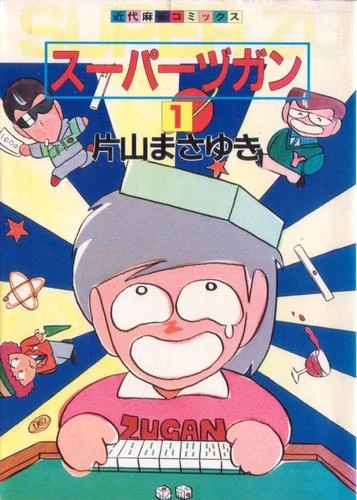
In conclusion, sell me the delightful comedy mahjong works of Masayuki Katayama. Literally only I will purchase any of these.